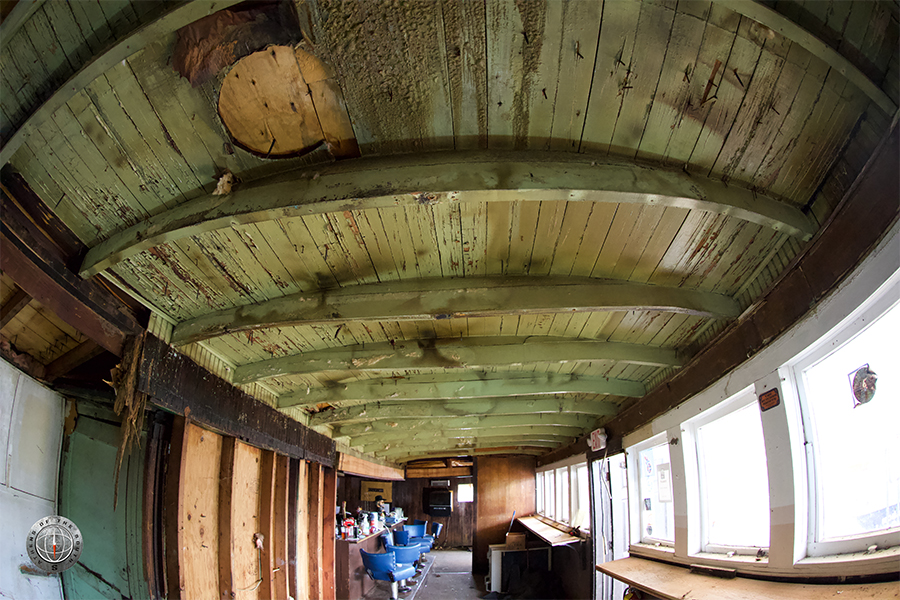
Last week 90% of historic Brown’s Diner Street Car #2 was demolished to make way for a larger diner kitchen. I observed the entire project and salvaged what I could, but very little of the original car was left, probably due to decades of updates, and at least two fires. They were fortunate that Ladder 16 was across the street for most, if not all of their 96 year old history.
The 4″x4″‘s underneath the floor were severely charred (I have several in my possession). Leaking grease from the grill is probably the accelerant for the fire below. I believe these are part of the original car, but what I found attached to them underneath, is another mystery.
Both cars have chassis that are clearly not from any known street cars, even mule drawn. A local expert surmises that the massive original Street Car iron wheels were salvaged and these were used to move the cars to their final resting place at Brown’s in 1927. The Car #1 wheels closely resemble those I found at the Ellington Agricultural Museum on farm equipment. The Car #2 wheels and chassis look very similar to old Circus Wagons. I would date both car chassis at around 150 years old.
Here is a 3D model of the documented components of Car #2. Note the pivot rings on the front end of the car. The video below illustrates their function.
This 3D image shows the remains of Car #2, about 7 feet of the original car length. The wheels and chassis are under the framing.
Nashville Inter Urban Railway
note: the term Trolley Car was never used for these vehicles
Most people call it a Trolley Car, but the actual terminology in “the day” was Road Railway or Street Car. Shortly after the American Civil War in 1866, Memphis and Nashville adopted these public road transportation vehicles. Initially they were horse and mule drawn vehicles. Then they were powered by small locomotives called dummy railroads, and around 1889 they began the conversion to electric power.
In 1927 Brown’s Diner was opened using two former street cars as the restaurant in the form of a “T”. Brown’s is the second oldest restaurant in Nashville and holds the oldest beer permit: #0007.
From the recent renovation, these images suggest that Brown’s Diner’s cars may have been powered by mules or horses. But the wheels don’t match the car, and the 38 foot car is too large to be animal powered. One expert thinks these wheels are not original to the car and were only used to move it from the rail line to its current location. Car #1 which is perpendicular to Blair Blvd, and has two blocks of wheel trucks intact which have flat iron wheels 26 inches in diameter. They are not cast-iron like typical street cars. They also lack the sprung and equalized mechanism (suspension system) designed into a four-wheel truck system.
These iron spoked wheels resemble ones I observed the other day at the Tennessee Agricultural Museum at the Ellington Center, mostly used on 19th century farm equipment.
Axle assembly 16 feet from the west end of the car.
How the cars got to this location is speculative, but about 6 months before Brown’s opened in 1927, Nashville hosted the “Parade of Road Railways”, which is featured in Ralcon Wagners book Nashville’s Streetcars and Interurban Railways. Brown’s Diner is located at the terminus of the Nashville Street Railways line at Blair Boulevard and 21st Avenue.
Road and Road Railway Map
The rafters of Car #1 are covered back up with insulation, but here is what it looks like above the new ceiling:
21 rafters spaced about 21 inches apart, except for the ones next to the flue.
Car #1 measures 38 feet long in the interior, 8 feet wide and 7.5 feet tall. Two sets of wheel assemblies are located 41″ from the south end of the original car, and 16 feet from the west end of the car. They certainly had more wheels than just four to move the car. Probably eight wheels on two four set groups.
Car #2 is yet to be examined, but one wheel was discovered near the intersection of Car #1. The mystery is the origin of that car because the wheel does not match any know street cars. It’s more like a wagon wheel consisting of wooden spokes and rim. It measures 32 inches in diameter.
Car #2 is either not a street car, or modified with these wheels to roll it into place. Examination will continue during the second phase of the renovation to begin sometime later this year.
From what has been examined so far, this 3D model represents the known structural elements of Car #1. I will make updates to it as more information is discovered.