Hospital N0. 8


Nashville Civil War Hospital

 Virtual Tour of the Church

The Downtown Presbyterian Church

Revised: 13 JAN 2016

1st-church

154 5th Ave N, Nashville, TN 37219

This Church was one of many buildings used in Nashville as a hospital, during the Union occupation of the city in the American Civil War. It was designated Hospital No. 8 and housed 206 beds. The basement was used to board horses for the U.S. Army.  As Old First Presbyterian Church it is designated a National Historic Landmark. The current building was built in 1848, but the instittution dates back to 1816 with two prior structures that burned.

A very unique Egyptian Revival Architecture style Church. – wikipedia

“Presbyterians have worshiped in Nashville since 1814. In that year, the First Presbyterian Church of Nashville built their first structure. After the Battle of New Orleans, the State of Tennessee presented General Andrew Jackson with a ceremonial sword on the front steps of the church. It survived until a fire destroyed it in 1832.

Rebuilding in that year, on the same site, the second building hosted the Inauguration of James K. Polk as Governor of Tennessee. That building burned down in 1848. The congregation then hired the Philadelphia architect William Strickland, who was in Tennessee to design and supervise the construction of the Tennessee State Capitol building, to design the present building.

During the Civil War, the building was seized by the United States government, and used as a hospital. Receiving reparations after the war”… read more

A great book about the Church history is First Church: A History of Nashville First Presbyterian Church – Three-volume Set available on Amazon. First Church – A History of Nashville First Presbyterian Church, Volume 3: 1955-2000

See a 360 virtual tour of Hospital No. 8 in panorama. The Nashville Church is available for private tours. Check their website for more information.

Virtual Tour of the Church

#battleofnashville #church #hospital
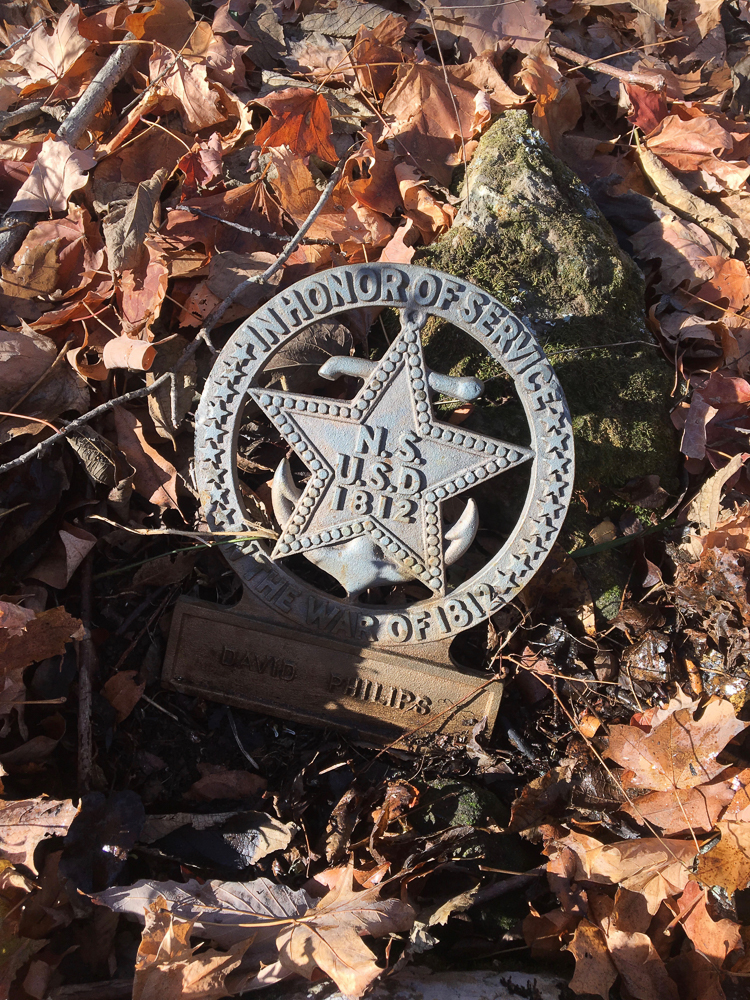
David Phillips

David Phillips Cemetery:

Bass Road, Cherry Valley, Tennessee (private property)

David Phillips, son of John and Mary Phillips, was born in Washington, County Pennsylvania December 11, 1794. Migrated to Tennessee at the age of three with his parents. He is our 4th American generation (A4) and the second David Phillips of that line.

Married Mary “Polly” Waters December 14th, 1820. She was the daughter of Shelah Waters, whom the city of Watertown is named.

Died: September 30, 1846 buried in the Phillips Cemetery on Hale Road (one of 3).

“David was a soldier in the War of 1812*, family lore says he fought with Gen. Andrew Jackson at New Orleans. The War of 1812’ files in the Tennessee State Library at Nashville show that there were 138 soldiers by the name of Phillips in the war and six of these were named David. One was a corporal under Colonel Benton, one was a corporal under Captain Gibbs, The three were privates under Colonel Lowry, Colonel Coffee and Captain McKee, and one was a drummer under Major Woodfolk.”

‘The Phillips Family History’ by Harry Phillips • Published by The Lebanon Democrat • 1935

Pension records list David as a Private.

david-phillips.JPG

The site of the War of 1812 soldier David Phillips Sr. is located on Bass Road in Watertown, Tennessee. His son Lt. David Phillips (CSA) is also buried there. There are also several U.S.C.T. headstones.

David’s N.S. U.S.D. marker is incorrectly located at his fathers cemetery on Hale Road a few miles away.

360º Virtual Tour

Recommended Reading:

Phillips Family History: A Brief History of the Phillips Family, Beginning with the Emigration From Wales, and a Detailed Genealogy of the Descendants … Pioneer Citizens of Wilson County, Tenn.

#warof1812

*History of Tennessee (1886), page 1112

The Battle of (west) Nashville

150 Years after The Battle of Nashville

Kelley's Point PhotoMany historians don’t know, or don’t believe, that much happened here at Bell’s Bend in the Battle of Nashville. But the Official Record refers to it specifically.

Most locals, consider Bell’s Bend to be the land on the north side of the Cumberland river. But if you were a sailor, it really didn’t matter. It’s the river channel location. It also makes sense, that the Confederate force was on the south side of the river, for several reasons: they were already on that side of the river coming in from Franklin, the river was impossible to cross anywhere close, it was higher ground, and it offered a better angle to shoot from in the apex of the river bend.

What is clear in the United States Navy Official Record, is that there were seven gunboats fighting in several engagements with land forces in the area starting on December 2nd, 1864. It included one Monitor, one Iron Clad and four heavily armed Tinclads under the command of Lt. Cdr. Le Roy Fitch USN.

Less than 48 hours after the bloody Battle of Franklin, Colonel David Campbell Kelley rushed to this location 9 miles downstream of Nashville. Kelley was probably under the direction of Nathan Bedford Forrest. It appears that Forrest was probably operating under his own directive at this part of the war (if not most of it) due to a verbal confrontation with Major General John Bell Hood at The Rippavilla Plantation two days prior. Forrest stayed clear of the direct charge at the Battle of Franklin, and was 40 miles away in Murfreesbooro when the Battle of Nashville took place. He probably saw the suicide in both operations.

Forrest did have several cavalry regiments detached to the Confederate left flank from December 2 to the 15th. U.S. Navy and Army records both estimate the enemy cavalry force much larger than it really was. On December 4th, the Navy thought that they had over a dozen cannon, when they probably only

Animation courtesy of R. Ryan Henderson

had four or less. The 6th Union Cavalry division commander, was convinced he was up against Forrest’s entire division after their advance on the 15th near here.

On arrival at this position late in the night on the 2nd, Kelley’s horsemen captured two Navy transports and disabled a third with artillery fire from the river banks. The southern cavalry was able to partially unload supplies and prisoners from these boats, before the Navy gunboat flotilla showed up and recaptured them. They held this ground for the next two weeks of the Nashville occupation.

There is strong evidence that they also used a position close by to set up a deadly union ambush on the late afternoon of December 15th with the sun at their back. An entire division was sent reeling back according to U.S. Army records. What happened after that is where the mystery begins.

There are far too many MIA’s and “desertions” with the Union Cavalry 6th Division.

I think I have found out why.