Day 4: Fredericksburg, Virginia. The visitor center was very helpful finding David’s position on the battlefield. I learned that they fought hard, standing their ground when two regiments to their immediate left broke and ran away. This opened up a huge hole in the line which filled with (ironically) Pennsylvania troops. The 7th held firm, despite fire coming in from 3 sides.
This is the precise position of Archer’s 7th Tennessee on December, 13 1862. It’s listed as Prospect Hill on the driving tour.
David Phillips was promoted to 3rd Lieutenant two months after Fredericksburg, probably because of his actions in that victory. A few months later, during the Battle of Chancellorsville, he would make 2nd Lieutenant. In that daring battle, Robert E. Lee’s finest hour, the 7th was sent straight up the middle towards a key primary objective: Fairfax. They were the tip of the spear here:
David Phillips went on to fight in many more battles. At Gettysburg he went straight up the center in Pickets Charge, captured at the Stone Wall. The 7th Tennessee lost 43% of their men in the assault. Out of the original 800+ men, they surrendered at Appomattox Courthouse with only about 50 of them.
My itinerary from Chancellorsville, was to Gen. Johnston’s surrender site in North Carolina, and then to Kings Mountain, SC where my 5th great grandfather, Captain James Maxwell fought with is son William, my 4th great grandfather. Based on the run of luck I was having, I decided to cut the trip short.
Later that rainy night, a semi blew a tire as I was passing it. It sounded like a cannon blast – that loud. Cousin Billy said that the yankee ghosts were after me. #3 out of the way. 😉
Just west of Cheat Mountain was the second prong of Lee’s attack at Elkwater, WV. The Union defensive position is an interesting remote site. It was originally an 18th century frontier fort against the Indians. By 1861, the strategic ground had become a cemetery. It’s the only fort I have seen built around a graveyard. Lee was unsuccessful here too. It was know as Camp Elkwater.
Heading due North, I drove through a very quaint small town in Beverly, West Virginia. The town visitor center has a great interpretive area housed in a former courthouse, circa 1801. There are numerous other historic buildings in town. The Battle of Rich Mountain is literally right up the road.
Rolling north into western Pennsylvania, I stopped in Washington, PA for the night. I like to plan my visits for Sunday traffic at the highest congestion points, if at all possible. So it was essential to get Philadelphia, Baltimore and Washington D.C. in my rearview mirror by the end of the next day.
Day 4: Southpark Township, PA was a short drive. I arrived early Sunday morning at the cemetery of David Philips, my 5th great grandfather. Reverend Philips, served the Lord here at Peters Creek Baptist Church for 43 years. Prior to that, he was a Captain in the 7th Chester County Battalion, during the American Revolutionary War.
Note: for some reason, the family Tennessee branch changed the name to Phillips with two L’s.
Things were on track for getting to Fort Delaware before the last ferry at 4 pm. This changed at a turnstile on the Pennsylvania Turnpike. The unexpected self-service cash receptacle required closer parking. I had to open the door to reach the cash slot. 100 miles later, I realized my wallet probably dropped out there (it was later found and turned over to police). Fortunately, I had a back up credit card, photo I.D. and cash stashed away.
The delay cost me about an hour, stopping to cancel cards and contact the authorities. If I made good time, I could still get to Chester County, on the other side of the state, and the last ferry to Fort Delaware.
I arrived in the beautiful upscale suburb of West Chester, PA about noon. The secluded Vincent Baptist Church was located on the edge of a wooded park. It was established in 1736, and the Church building is from 1812. The cemetery contained the remains of my 6th great grandfather: Joesph Philips. He is the first generation emigrant from Pembrokeshire, Wales. There were at least 30 more Philips buried around him in a long line. Most of the headstones had new metal tablets, with the inscriptions from 200+ year old, fading headstones.
Shooting four photospheres took about an hour (with a neighbors inquiry about what I was doing there). I was close to the go-no-go point of making it on time to the ferry.
I arrived at 10 minutes to 4 PM at Fort Delaware State Park. The park didn’t take Discover for the $14 fee, but waived the rules to let me write a check (I was hoarding my cash for the unknown remaining tolls).
Fort Delaware was one of the POW prisons my second great uncle David Phillips occupied. He was captured twice during the war, so he got two tours of the fort.
I had a little under an hour and a half to shoot as many 360º’s as I could. During the robot’s fourth gyration, I was talking with some young park rangers about my great uncle. An older park ranger inside heard me mention David Phillips. He came out with a photo of the young lieutenant, which he only received days before. My guess is their social media director caught a few tweets I have done recently about David and the fort.
Heading south from Delaware, I used up my last $3 on the final toll booth of my journey near Baltimore. I hate turnpikes! Arrived late at The Hampton Inn near Fredericksburg, Virginia.
I knew that a massive tire failure, one hour into the 2000 mile trip, was a bad omen. Two cans of fix-a-flat were ineffective on the defective one year old Continental rear tire. The $100 transport to the nearest Discount Tire store was performed by the best wrecker operator I have ever used*. We had lots of stories to share. It was an entertaining two hour diversion.
*Patrick, with Ron’s Towing of Sparta, even knew were the hidden towing eyelet was for the wench on my 530i. He educated me, NEVER let a tower use the wench as the only front secure-point. Each wheel should be tied to the bed rails.
$35 new Michelin Pilot Road 2, courtesy of the Discount Tire Road Hazard plan. Thank you Discount Tire!
Stoped for a short visit with high school buddy Scott Michael Sefsik on Center Hill Lake. Calculated a re-route, destination Kingsport for the night @ 3 hours.
Great sundown at Sunset Rock just past Sparta! (site of my first Rock Repel with Camp Widjiwagan). Got the last bracketed 100 image photosphere, just as the sun hit the horizon.
Day 2: Left Kingsport for Emory & Henry. Beautiful campus! Toured the 1836 Wiley Hall building, where my Great-Great Grandfather Walter Scott Bearden attended, before and after, the American Civil War. Beautiful campus! Wiley Hall is the site of the original college building, also used as a Confederate Hospital. In 1864 it was the location of a famous murder: a wounded U.S. Army officer shot in bed by Confederate Guerrilla raider Champ Ferguson.
Heading north, I stopped at Saltville, Virginia just up the road. “The Salt Capital of the South” was a Southern strategic resource. Salt was the primary means of preserving meat for the Civil War armies. A large battle was fought here in October 1864. The wounded were taken to Emory & Henry College not far away.
Pressing north into Western Virginia, I drove through the most scenic part of the Appalachian Mountains I have ever traversed. This is home to the George Washington and Jefferson National Parks. It reminded me of the Smoky Mountains, without all the tourists.
Warm Springs Virginia was home to David Phillips and the 7th Tennessee for the month of December in 1861.
Camp sites were plentiful at Hidden Valley Campground (no online reservations) just west of Warm Springs. I was pleasantly surprised to get a private Friday night camp site with vacancies on both sides. Firewood was plentiful not far from the site. New Bucket List Addition: Beautiful old Bed & Breakfast Mansion in this scenic valley: Hidden Valley B&B. Wish I had taken a pano here.
Day 3: I followed the 7th Tennessee’s trail north-west to Cheat Mountain, WV, site of Robert E. Lee’s first offensive of the Civil War. At 4000′ above sea level, it is the highest known Civil War fort in the country.
A road trip down the Bearden, Maxwell and Phillips history trail, including battle sites of the 7th Tennessee and cemeteries of my first two generations of Phillips in America. 360º imagery will be captured wherever possible.
I am a direct descendent of Captain Walter Scott Bearden, 41st Tennessee CSA, Private James Jarvis Maxwell, 4th Tennessee Cavalry U.S. and John Bond Henderson, 4th Tennessee Cavalry CSA| Uncle (G3) Lt. David Phillips 7th Tennessee CSA, and Great (G3) Cousin Major Shelah Waters 4th Tennessee Cavalry U.S.
National Archives: research will be conducted on Lt. David Phillips III, David Phillips, II and Major Shelah Waters
“I can hardly turn a page of Tennessee history without finding my relatives fingerprints on them.”
From Tennessee founding father Richard Henderson (Hendersonville namesake) to the long line of Phillips military heroes, to the Grand Ole Opry, I can’t turn a page of Tennessee history without connecting a relative to it. My great-great grandfather William Washington Kerr, ran a grocery on Carroll Street in Nashville. My grandmother started a free school meal program at Howard school, food provided by her fathers Grocery. At the time of her death, the Tennessean reported it to be a first of it’s kind.
Notable Kin:
Captain / Reverend David Phillips – Revolutionary War Pennsylvania Militia
Captain James Maxwell* (1725–1806) – Revolutionary War
William Maxwell (1756–1838) – Revolutionary War – King’s Mtn.
Wilson L. Waters – Industrialist, Whig Party leader, Watertown namesake
Captain Walter Scott Bearden – 41st Tennessee CSA – Chickamauga, Chattanooga, Fort Donelson, etc. Wounded 3 times Battle of Atlanta (his twin brother Edwin Bearden was an officer in the same regiment). Chancellor Circuit Judge Shelbyville, Tennessee.
2n Lt. David L. Phillips – 7th Tennessee CSA – Pickets Charge, Gettysburg, Fredericksburg, Chancellorsville, Seven Pines, etc.
Major Shelah Waters – 5th Tennessee Cavalry USA, Presidential nominee as Minister to Ecuador and IRS assessor.
Edwin Bearden – Judge Shelbyville, Tennessee
Water Scott Bearden, Jr. – Founder of National Life & Accident Insurance Company
Joseph Macpherson – New York Metropolitan Opera. First vocalist on WSM radio. Old Hickory Singers.
W.E. Henderson – 2nd Lt. 77th New York Regiment, 82nd Infantry – Arden Forrest Champaign- Sales Manager Southwestern Company
Harry Phillips – author of The Phillips Family History, Lt. Cdr. U.S. Navy WWII, Tennessee House of Representative, Assistant Tennessee Attorney General, Federal 6th Circuit Court of Appeals
* Father of James Maxwell: Alexander 2nd Baronet of Monreith Maxwell was born in 1682 in Monreith, Wigtownshire, Scotland, to Elizabeth Heiress of Park Hay, age 28, and William 1st Baronet of Monreith Maxwell, age 47.
Company K – Captain Robert Hatton, Thomas H. Bostick, Archibald D. Norris – “The Blues” – Men from Wilson County. [2]
06 JAN 2017 | Tennessee State Archives |
Yesterday, I learned that there are more details after David’s last diary entry March 7, 1863.
Yesterday, an hour prior, I located his cousins service revolver and two red sash’s on display in the Civil War section of the Tennessee State Museum. *As of 2020, they had been removed after the State Museum moved to The Bicentennial Mall Mall.
Yesterday, Major Waters USA and Lt. Phillips CSA swirled around my head like the snow on Capital Hill. I looked up at Sam Davis, as I turned the corner on 7th to the state archives, praying David’s diary was where it should be. Not only did I find it, I also uncovered a lot about my Waters side of the family. An article written for the Wilson County Bicentennial, explains their Union support of the war, in a town that was very Confederate.
Major Shelah Waters
192 days ago, I went to the Nashville National Cemetery to shoot the Boy Scouts planting flags for Memorial Day. My last shot was down a row of Civil War veteran headstones to capture the Minnesota Monument in the background. As I was standing up, I recognized a family name that was familiar, because it is so odd: Major Shelah Waters. There are over 20,000 Civil War graves alone in that cemetery. I randonally choose this one to lay down in front of.
David was captured for a second time (first at Seven Pines) at The Stone Wall in Pickets Charge. In that suicidal attack, the 7th were part of a handful that made it to The Angle, losing 118 out of 276 men (43%). This has been described as the high-water mark of the Confederacy.
These are exciting developments which add to the drama of this amazing man. The source of this material can be found on this FaceBook site. A great book about the 7th Tennessee is The 7th Tennessee Infantry in the Civil War: A History and Roster, William Thomas Venner on Goodreads.
In his diary, there were a number of pages in the front and back of the two pocket diaries, that have not been transcribed. I have included them here in this PDF. I could probably use some help with transcriptions.
Thomas and Shelah Waters
Major Shelah Waters
Watertown, Tennessee
My GGF’s brother, Lt. David L. Phillips, signed up for the Confederacy right after his state of Tennessee entered the American Civil War June 8, 1861. He served in Virginia all the way from Cheat Mountain to Appomattox Courthouse, being captured twice, exchanged once and escaped once.
It must have been a difficult decision for him, as Wilson County Tennessee was bitterly divided. His first cousins, Major Shelah Waters (male), Major Thomas Waters, enlisted/commissioned on the Union side with the 5th Cavalry Tennessee U.S. Shelah and David were classmates at Union University in Murfreesboro, Tennessee (Waters in 1857-1860 and Phillips in 1857-1861). David Phillips was a brother of Phi Gamma Delta, which is inscribed in his diary. Cousin Shelah was too. The history of Phi Gamma Delta at Union University.
Members of the extended Phillips family line in Watertown, Tennessee who fought in The War Between the States:
27 Confederate | 7 U.S. Army
Watertown Confederate Army
Smith Allen KIA Franklin CSA
Elias Benjamin Bass CSA
John Bass Captain CSA
John L. Bass CSA
Thomas Bass KIA d.1865 CSA
Thomas Bass KIA d.1863 CSA
John Wiseman Bass Captured CSA
William Emsley Bass CSA
Petter Donnell Co. C 4th TN Cavalry CSA
William Evans CSA
David Wilson Grandstaff captured 4th TN Cavalry CSA
David Wilson Grandstaff 1st LT 4th TN Cavalry Co. C CSA
Isaac Preston Grandstaff CSA
Samuel Archibald Grandstaff KIA Stones River CSA
William Dillard Grandstaff CSA
Samuel B. Lambert CSA
Benjamin Phillips CSA
David L. Phillips – Union University – 2nd Lt. 7th Infantry
James Madison Phillips – Union University – Major Forrest 4th TN Cavalry CSA
John Phillips CSA
Joshua Phillips CSA – Wounded at Shiloh, lost one eye, farm ransacked by Union
Matt Phillips Captain CSA
Sion B. Phillips CSA
Thomas Phillips CSA
William Phillips Forrest – Stones River – Shot off his horse – CSA
William Preston Phillips Forrest CSA
Edward Price CSA
Watertown United States Army
Ezekiel Bass Captain USA
John Berry USA
George Oakley KIA USA
James Oakley Captain USA
John Wilson Phillips USA
Shelah Waters – Union University – Major 5th TN Cavalry USA
Thomas Waters – Union University – Major 5th TN Cavalry USA
His diary accounts for almost ever day of his war – up until the regiment started taking significant lossesin late May of 1862. Like most combat veterans, the narrative stops.
David did not reconnect with his sweetheart after he returned home from the war. He returned to teaching, and died less than four years later in 1869.
David Phillips Diary – book 1 of 2
Reading between the lines:
The drawing on the front page of David’s diary appears to be a Waning CrescentMoon behind the phrase “Nil desperandum” latin for never despair. David was of Welsh (Celt) ancestry. It could also be a “C” for confederate.
“There is a moon goddess also worshiped by the Celts, who is associated with the lunar cycles. The word ‘crescent’ comes from the Latin term ceres meaning to ‘bring forth, create’ and crescere, the Latin term for ‘grow, thrive’. Waning Crescent: symbolizes the expulsion of negative energy in your life, getting rid of things you know you don’t need, or those things/people/habits, etc which are harming you.” – DaphneShadows
Excerpts from Davids Diary:
“December 3rd [1861]. Archie and I went to Rockbridge Alum Springs [Virginia] on a looking expedition. The buildings at the Springs are very nice. There are a good many sick soldiers in the rooms of the hotel which are used for a hospital. We got a splendid dinner at the hotel which in part is still devoted to the entertainment of visitors. Came back to camp in evening.”
“December 4th. Got a letter from John [brother] from which I learned he was about to volunteer**. Went to Old Millboro in evening with Justiss. Made the acquaintance of a merry old toiler. Bought some apples from him and got a splendid supper at his house. Returned to camps by dark. Gilham’s regiment left for Staunton on the evening train.”
“December 13th. Day fine. Archie and I had a regular old corn shucking scuffle. It was ‘give and take’ for some time; finally Archie was routed, having got a sore knee and a bruised hand. During the contest we rendered tent ‘hors du combat’ by knocking it down. Captain Bostic got back from home at night; boys glad to see him. He brought a great many letters for the regiment. None for me. Through some that he brought I learned with regret that Tommy, Levi, and Luster* had been drafted. Bad news from all quarters about home.”
3rd Lt. Phillips circa 1863
“December 16th. Up early preparing for our march. Boys didn’t like the idea of going on the Potomac. Got ourselves ready for traveling about 9. Left camps enroute for Strasburg about 9:30 a. m. We went through Staunton and took the valley turnpike. Went through town with colors flying and drums beating. The ladies greeted us by waving handkerchiefs. Some I noticed weeping at, as I supposed, the recollection of son or husband who were away soldiering like us. Found the pike to be a real one running through the finest country I have seen in Virginia. The inhabitants very hospitable and generous. There seemed to be a dearth of young and middle aged men. Marched about 8 miles and camped just beyond Willow Spout Spring. Adjacent to the camp ground was an old stone church in a cluster of large oaks. Preaching was appointed in the church. Went to attend the services, found the house crowded. The church is called Stonyfort and is said to be about 125 years old. Parson Boydston preached and after preaching the pastor (a fine looking man of 35 or 40) gave us a most eloquent and impressive talk.”
“December 31st. The last day of 1861 has come. I am still living the life of a soldier. I see no prospect for peace in the incoming year. Oh, how my heart would leap for joy if peace were declared and I permitted to return. I look back over my past year and see nothing of profit I have done. May my hour of usefulness soon come. I am tired of doing nothing and gaining nothing. The sky indicates rain, the sun refuses to shine. It seems as if the dying year would weep over the unhappy state of my country. May the bright sun of peace soon light up and enliven our sunny South, making our firesides happy and our homes the homes of peace. The year of 1861 aieu forever.”
– Private David Phillips
“Seeing The Elephant”
In 1862, Hatton and his men were ordered to the Richmond area to stop Federal Maj. Gen. George B. McClellan’s drive on the Confederate capital. During the resulting Peninsula Campaign, Hatton served with distinction, and on May 23, 1862, he was promoted to brigadier general of the 4th Brigade, 1st Division, Army of Northern Virginia; this appointment was not confirmed by the Confederate Congress.Just eight days later, he was shot in the head and killed while leading his Tennessee Brigade at the Battle of Fair Oaks. -Wikipedia
In May of 1862, enlistments were up and new officers elected. This resulted in a new command structure that was leaner and more competently led, but bad news from home arrived: the utter route of Gen. John Hunt Morgan in Lebanon, Tennessee. The men of Wilson County were infuriated by the news.
“Shockingly, the boys from Wilson County received a report of a ?ght right in the streets of their home town—Lebanon. An astonished Robert Hatton wrote, ‘The Yankees are in Lebanon? My house surrounded by a hostile foe.’ This initial story was soon followed by successive accounts of the ?ght, each story providing details of appalling verity—not only had Confederate troops been defeated, they had run away! Colonel Hatton reacted: ‘[ I am] disgusted at … what I heard.’ David Phillips wrote, ‘Oh, how distressingly sad it is to be so completely cut off from home.’” – The 7th Tennessee Infantry in the Civil War
Protests were made by Tennessee regimental commanders to be reassigned to their home state. They fell on deaf ears in Richmond, Virginia. Colonel George Maney (Franklin, TN), forced the issue, employing his political connections to be shipped back home, but no others. The 7th were dumfounded by this news.
The first dance with the Grim Reaper began on May 31, 1862. Spirits were high, as their beloved 36 year old Col. Robert “Bob” Hatton, was promoted to General in command their Brigade (the 1st, 7th, 14th Tennessee and a four gun battery called Braxton’s battery). On the night of May 30th, 1862, General Hatton received word to prepare his troops for battle. “If I should not return, be a mother to my wife and children.” he prophetically wrote to his parents. To his wife Sophie: “The struggle, will no doubt, be bloody; that we will triumph, and that gloriously, I am confident. Would that I might bind to my heart, before the battle, my wife and children. That pleasure may never again be granted to me. If so, farewell; and may the God of all mercy be to you and ours, a guardian and friend. “If we meet again, we’ll smile; If not, this parting has been well.” Affectionately, your husband, R. Hatton.”
The next morning General Hatton marched his brigade 7 miles along the Richmond – Yorktown rail line. As the Tennesseans hurried toward the conflict they passed President Jefferson Davis, and also caught glimpses of Generals Joesph E. Johnston and Robert E. Lee along the way. The entire Confederate high-command were on the sidelines watching this unfold.
Around 2 PM Hatton received orders to fight.
Fair Oaks Virginia: “The occasion is at hand, and I confidently expect that you will acquit yourselves as noble heroes” “load”, “fix bayonets” and finally “forward, guide center.”
In an oat field, just north of Fair Oaks, Hatton’s Brigade attacked, in the open, a brigade of Massachusetts and Michigan regiments embedded in thick woods. Early in the battle, Hatton had his horse shot out. Saber raised, he coolly moved forward on foot a short distance, before being struck down by shot or shell. He died before anyone noticed him.
A 1000 man volley decimated the green Confederates. Finally, after darkness enveloped the battlefield, the order was given to withdraw. The 7th began it’s slide to the rear, but in the darkness and tangled foliage, Private Phillips Company K stumbled into union lines and had no choice other than to surrender. He was sent to Fort Delaware. He would be exchanged 3 months later.
144 out of 594 7th Tennessee young men were claimed in the Battle of Seven Pines (24%). General Hatton remains, in stone, on the Lebanon Town Square.
Gen. Hatton | Lebanon Square
Gen. Bob Hatton
“The Curtain Falls”
“March 7th, 1863. Time has slipped away like magic since last I wrote in this book. Nearly seven months gone with their burden of marches, toils and battles. Five battles have I witnessed and in which I was actively engaged. Many miles I have marched till worn and weary, but here I am sound and well, enjoying life as best I can. For the past three months we have had an easy time, but the next six are to be dreaded. I hope I may always have such luck as I have had thus far, except ‘the lean streak’ I had at Fort Delaware.”
“May 10th [1862]. The events that have transpired since the first have been too extensive and important to attempt to record them here . I will have to leave them to memory to keep. Much of toil, weary marching, sleepless nights and hard fighting has fallen to the lot of this army since it left Yorktown. By the Gracious Providence of God I am here sound and unhurt. While I am preserved from the dangers of camps and the battlefields , sad news comes to me from home. Intelligence has come to me that I have lost a dear, much-beloved brother [Rev. John Phillips].
Oh, how distressingly sad it is to be so completely cut off from home that I cannot know only perchance whether loved ones there live and are well or laid low by disease and death . Fondly had I cherished hope that I would meet that beloved brother again, but death hath separated us. Thus have I seen one of my fondest earthly hopes decay. The next stroke may remove me from those who will be left behind . Yet how consoling it is to think of meeting him in Heaven. There we shall know no separation. It is the sacred hope of meeting my friends in Heaven if not on earth that animates my soul and nerves my arm to withstand the temptations of life around me, endure the afflictions of the soldier and willingly risk my life on the battlefield. This life is full of desperations and dangers, full of sorrow and grief, but in the next oh how happy all shall be who while here love God and keep His commandments!”
– DAVID L. PHILLIPS
Fort Delaware
May 1863 Muster
During the Battle of Fredricsburg, the 7th Tennessee held there ground against Gen. George Mead’s division despite having 2 regiments to their left break and run. Pennsylvania regiments poured through the large gap in their line. The 7th was now taking fire from 3 directions. Ammunition ran low on both sides and brutal hand to hand combat followed. There were at least two Pennsylvania soldiers that were from David’s grandfathers birthplace in Allegheny County, PA. I am researching to see if they were cousins of his. One is named David C. Philips, and was with the 5th Pennsylvania Infantry. February 2, 1863 David was promoted to 3rd Lieutenant.
In Robert E. Lee’s masterpiece Battle of Chancellorsville, the 7th was sent straight up the middle of the assault. May 3, 1863 after the Battle of Chancellorsville he made 2nd. Lt.
David Phillips was captured again at Gettysburg on July 3, 1863, during Pickett’s Charge. What was left of the 7th made it all the way to The Angle in the ill fated assault on Cemetery Hill. (Union muster records conflict with this capture date. One is July 1, 1863 and the other is July 3 at Gettysburg).
He was transferred from prison at Ft. McHenry, to Ft. Delaware, to Johnson’s Island and to Point Lookout for exchange on March 14, 1865. Sometime between his arrival at City Point and the surrender at Appomattox he must have slipped away before being able to re-join the regiment. He reported to Federal authorities in Charlotte, NC, May 1, 1865, and took the Oath in Nashville on Aug 1, 1865.
Timeline:
Yesterday, I held my GG uncles diary in my shaking hands.
The approximate route of the 7th Tennessee up to the Battle of Seven Pines.
“David returned to Wilson County broken in body. The brutal exposure, long marches, starvation, particularly during his imprisonment at several POW camps, had wrecked the physique one strong and stalwart. David had a sweetheart in Tennessee, to whom he refers several times in his diary. Probably his poor health was responsible for his never marrying. After the war he went back to his old profession of school teaching. He sought vainly to regain his lost health, but the ravages of the war were too great.”
The “White Plague” (typically from tuberculosis and other diseases, that consumed 7.5% of the prison population) took root in the body that had marched courageously under the Stars and Bars, and on May 18, 1869, the loyal brave heart was stilled.” David is buried in the Phillips Cemetery near Watertown on Bass Road. Ironically, it also holds four members of the 40th Tennessee USCI (United States Colored Infantry).
‘The Phillips Family History’ by Harry Phillips • Published by The Lebanon Democrat 1935
7th Regiment, Tennessee Infantry CSA
OVERVIEW:
1APR1839 – 18MAY1869
7th Infantry Regiment completed its organization at Camp Trousdale, Sumner County, Tennessee, in May, 1861, and in July, moved to Staunton, Virginia. The men were raised in DeKalb, Smith, Sumner, and Wilson counties. It participated in Lee’s Cheat Mountain Campaign and for a time served under General T.J. Jackson. Later it was assigned to General S.R. Anderson’s, Hatton’s, Archer’s, and McComb’s Brigade. It fought with the Army of Northern Virginia from Seven Pines to Cold Harbor, then was involved in the long Petersburg siege south of the James River and the Appomattox Campaign. This regiment reported 72 casualties during the Seven Days’ Battles, 34 at Cedar Mountain, 26 at Second Manassas, and 38 at Fredericksburg. It lost 11 killed and 45 wounded at Chancellorsville, and forty-six percent of the 249 engaged at Gettysburg. The unit surrendered 6 officers and 41 men. Its commanders were Colonels John A. Fite, John F. Goodner, and Robert Hatton; Lieutenant Colonels John K. Howard and S.G. Shepard; and Major William H. Williamson.
A great book about the 7th Tennessee is The 7th Tennessee Infantry in the Civil War: A History and Roster, William Thomas Venner on Goodreads.
Post script 6 January 2019: I found this (lebanon_herald) in the TN State Archives the other day. From around 1858 to 1878, there were only 2 days of Newspapers from Lebanon. Here is October 21, 1865 (the other paper was the 28th).
I am pretty sure this is our David Phillips. His friend Archie Norris (they served in the 7th TN, Co. K and mentioned several times in Davids diary) is mentioned, as well as Thomas Waters (Shelah’s brother).
The second generation of my American ancestors, resided in South Park Township, Pennsylvania. David Philips was born in Wales in 1742 and migrated with his fathers family to Chester County, PA in 1755. He is the son of Joseph and Mary Philips, our first American Ancestor (A1).
Possible Location of the Philips Home
American Immigrant Generation II – REV. DAVID PHILIPS
“The Reverend/Captain David Philips was emphatically the leading clergyman of the pioneer days of Peters Township (now South Park Township, PA). He was born in Wales in 1742, and emigrated from that country to America with his father’s family, settling in Chester County, PA. He married during his residence at that place, and in 1783 came into Washington county and took out a warrant for land which now lies in both Allegheny and Washington Counties. This tract of land was surveyed to him as 390 acres, under the title of ‘Norwich’, and he obtained the patent for it March 4, 1786.”
“This quotation from the History of Washington County, PA., (1882), page 891, gives an insight into the life of service of that great pioneer Baptist preacher, David Philips, eldest son of Joseph.”
“Following his years of heroic service in the war (The American Revolution), David Philips accepted the Macedonian call to what was then the American frontier, in Washington County, southwestern Pennsylvania. He was ordained by the Peters Creek Baptist Church in his new home, and was immediately called to the pastorate thereof. At the same time he supplied the Finleyville, Elizabethton and Budd’s Ferry Churches.”
“The Rev. David dedicated a portion of his land to the Peters Creek Church, and assisted in the erection of a roomy log Churchhouse. This structure served the congregation throughout his ministry, and was replaced with a brick building in 1832. The Peters Creek Churchhouse stands today on the land which David Philips donated and dedicated to it a century and a half ago.”
Join the fight for liberty and independence?
“All four were active in organizing the Seventh Battalion, Chester County Militia. David Philips was Captain of Company 2, and Josiah a 2nd Lieutenant. All four brothers distinguished themselves for bravery. Joseph Jr. was an Ensign in the same battalion. Josiah was an associator and acted as scout when the army was at Valley Forge. John Philips was taken captive in New Jersey and in confinement in a prison ship at New York, where he was ministered to by his devoted wife.”
“It is recorded in the D.A.R. Lineage Books that the four brothers raised the company and distinguished themselves with bravery and heroic suffering.”
‘The Phillips Family History’ by Harry Phillips • Published by The Lebanon Democrat • 1935
Two of David’s sons John and Benjamin, migrated to Tennessee in 1797* The Phillips name changed to two “L” after that migration.
*Page 9 – ‘The Phillips Family History’
Whitechurch in Pembrokeshire: http://www.visionofbritain.org.uk/place/9459
Bass Road, Cherry Valley, Tennessee (private property)
David Phillips, son of John and Mary Phillips, was born in Washington, County Pennsylvania December 11, 1794. Migrated to Tennessee at the age of three with his parents. He is our 4th American generation (A4) and the second David Phillips of that line.
Married Mary “Polly” Waters December 14th, 1820. She was the daughter of Shelah Waters, whom the city of Watertown is named.
Died: September 30, 1846 buried in the Phillips Cemetery on Hale Road (one of 3).
“David was a soldier in the War of 1812*, family lore says he fought with Gen. Andrew Jackson at New Orleans. The War of 1812’ files in the Tennessee State Library at Nashville show that there were 138 soldiers by the name of Phillips in the war and six of these were named David. One was a corporal under Colonel Benton, one was a corporal under Captain Gibbs, The three were privates under Colonel Lowry, Colonel Coffee and Captain McKee, and one was a drummer under Major Woodfolk.”
‘The Phillips Family History’ by Harry Phillips • Published by The Lebanon Democrat • 1935
The site of the War of 1812 soldier David Phillips Sr. is located on Bass Road in Watertown, Tennessee. His son Lt. David Phillips (CSA) is also buried there. There are also several U.S.C.T. headstones.
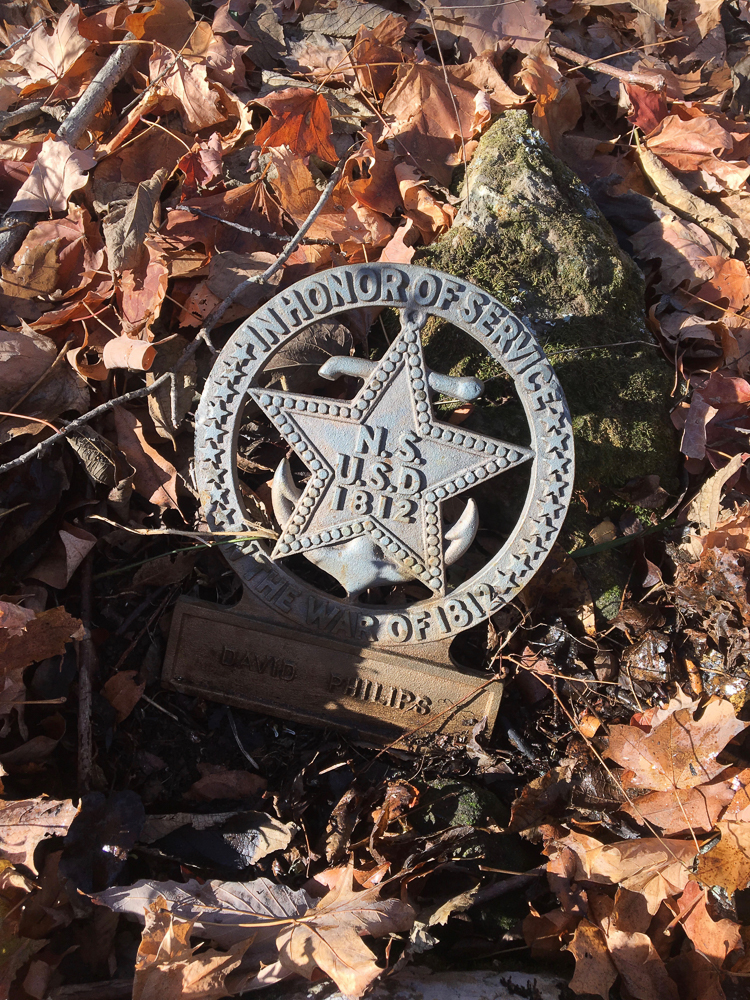
David’s N.S. U.S.D. marker is incorrectly located at his fathers cemetery on Hale Road a few miles away.
John Phillips: eldest son of David Phillips (1794-1846), he is the 5th generation of American ancestors (A5), and the second John of that line. He was my Great-Great Grandfather.
“John Phillips was born on his father’s farm near Cherry Valley, Tennessee, October 23, 1821, and married Miss Rebecca Williams December 5, 1845. He joined the Round Lick Baptist church in young manhood, and on the fourth Sunday in April, 1848, was ordained a Baptist minister. Going into the work actively from the very beginning, he held pastorates at Barton’s Creek, Cedar Creek and Providence, and in June, 1852, was called as pastor of the Fall Creek Baptist church at what is now Norene, Tennessee, which position he held until his death. He also did wide evangelistic work.* John was administrator of his father David’s estate. In addition to his activities as a minister, he owned and operated a 284-acre farm in the 18th district of Wilson County. He had eight children: Mary Ann Frances, William Anderson, Margaret America, Julius Wilson, Martha Jane Howard, John Houston, J. R. Graves and Sarah Rosetta. John Phillips died prematurely and unexpectedly.”
*Grime’s History of Middle Tennessee Baptists, pages 249-250
Letter from John’s brother who was fighting in Virginia with the 7th Tennessee (CSA):
“Thus have I seen one of my fondest earthly hopes decay.”
“December 4th [1861]. Got a letter from John [brother] from which I learned he was about to volunteer.”
“May 10th [1862]. The events that have transpired since the first have been too extensive and important to attempt to record them here . I will have to leave them to memory to keep. Much of toil, weary marching, sleepless nights and hard fighting has fallen to the lot of this army since it left Yorktown. By the Gracious Providence of God I am here sound and unhurt. While I am preserved from the dangers of camps and the battlefields , sad news comes to me from home. Intelligence has come to me that I have lost a dear, much-beloved brother [John].Oh, how distressingly sad it is to be so completely cut off from home that I cannot know only perchance whether loved ones there live and are well or laid low by disease and death . Fondly had I cherished hope that I would meet that beloved brother again, but death hath separated us. Thus have I seen one of my fondest earthly hopes decay. The next stroke may remove me from those who will be left behind . Yet how consoling it is to think of meeting him in Heaven. There we shall know no separation. It is the sacred hope of meeting my friends in Heaven if not on earth that animates my soul and nerves my arm to withstand the temptations of life around me, endure the afflictions of the soldier and willingly risk my life on the battlefield. This life is full of desperations and dangers, full of sorrow and grief, but in the next oh how happy all shall be who while here love God and keep His commandments!”
‘The Phillips Family History’ by Harry Phillips • Published by The Lebanon Democrat 1935
Most Phillips men lived way past the average mortality rate (about 44 years in 1860). A previous ancestor reached 101. The Phillips clan also had a very high percentage of their children reach adulthood, also very rare for the times. The odds of Rev. John Phillips dying of natural cause in April 1862 at age 40, is rather low.
Joesph Phillips (A1) – age 101
Reverend David Phillips (A2) – age 87
John Phillips (A3) – age 84
Rev. John died on Tuesday April 15th, 1862, seven days after the epic Battle of Shiloh (April 6-7, 1862). Corinth, Mississippi (retreating point of the Confederate Army) would have probably taken seven days by horseback to Watertown, Tennessee (205 miles via the Florence, Alabama Tennessee River crossing point @ 30 miles per day).
Killing Pro Confederate Preachers? Coincidence? We will probably never know.
One of the first settlers in Watertown, Tennessee (then known as Round Lick, also know as Three Forks) was John Phillips. John Phillips (1768-1846) is our GGGGGF. John is the son of Reverend/Captain David Phillips (A2). He is the third generation (A3) of America ancestors, and the first born “Phillips” in the United States.
Other family names at this site, include Oakley and Bass. Earliest burial I could find was 1840.
The John Phillips Log Cabin circa 1802?
This rare two-story hewn timber log cabin may be one of the oldest in Wilson County, Tennessee. It was to home of John Phillips and was occupied by several generations. The property was deeded in 1801.
Old log cabins can be dated to a very specific point in time:
Dendrochronology (or tree-ring dating) is the scientific method of dating tree rings (also called growth rings) to the exact year they were formed in order to analyze atmospheric conditions during different periods in history.
John’s father, Rev. David Phillips (one of several by that name), was a Revolutionary War veteran. Could this be his land grant?
Normally cut timbers would be cured for 12-24 months, which potentially dates the cabin to 1802 or 1803. The core cabin’s exterior measures 24′ wide, 19′ deep, 13′ to 16′ tall.
“The settlers followed the West fork of the creek until they came to a big spring in the canebrake, and it was there that they made their final halt. John Philips built his home only a short distance from the spring. The farm where John Philips settled is known among the old folks around Watertown as the Henry Bass place. It is now owned by Mrs. Annie Patton, widow of Cecil Patton. The log house which John erected still stands, but has been covered with weatherboarding, and other rooms have been added to the original dwelling”
‘The Phillips Family History’ by Harry Phillips • Published by The Lebanon Democrat • 1935
We found this by shear luck. It turns out, the property owner is a friend of my brother Blake Henderson.




 Most Phillips men lived way past the average mortality rate (about 44 years in 1860). A previous ancestor reached 101. The Phillips clan also had a very high percentage of their children reach adulthood, also very rare for the times. The odds of Rev. John Phillips dying of natural cause in April 1862 at age 40, is rather low.


